








Years before most people had heard the word “smartwatch,” a University of Waterloo engineering student was soldering one together. Venture capitalists passed on it. So in 2012, he asked the public for $100,000 on Kickstarter and got more than $10 million, a record for the site at the time.
The student was Eric Migicovsky, and the watch became the Pebble.
An annoying phone on a bike
Migicovsky was born in Vancouver and moved to Ontario to study systems design engineering at Waterloo. In 2008, during a year abroad at Delft University of Technology in the Netherlands, he cycled everywhere, and his phone kept buzzing in his pocket. Checking it meant taking a hand off the handlebars. MIT Technology Review and WIRED both tell the story: he wanted a watch that would show him who was messaging without pulling out his phone.
“I started working on Pebble in 2008 to create the product of my dreams,” he later wrote on his blog. “Smartwatches didn’t exist, so I set out to build one.”
Started in a Waterloo student startup program
Back in Waterloo, the project took shape in VeloCity, the university’s residence for student entrepreneurs. The university’s Daily Bulletin says his first watch, inPulse, “began as a project during his days as a VeloCity resident in the fall of 2008.”
BetaKit reports that he formed his first company, Allerta, one year before he graduated. inPulse worked with BlackBerry phones, the obvious choice in Waterloo at the time. Waterloo says he built the early watches with a group of friends, and Migicovsky finished his engineering degree in 2009.
From “no” to a Kickstarter record
The company was accepted into the Silicon Valley startup program Y Combinator in 2011, but raising more money was hard. CBC News reports that Migicovsky turned to Kickstarter in April 2012 after failing to convince venture capitalists to fund Pebble.
The new watch used an e-paper screen and worked with both iPhone and Android. The goal was $100,000. After 37 days, the campaign had raised $10,266,845 from 68,929 backers, according to the Kickstarter campaign page and WIRED. CBC rounds it to $10.3 million.
Pebble did it again in 2015. Its Pebble Time campaign passed $1 million in 49 minutes, the fastest Kickstarter project to that milestone, the University of Waterloo said.
Why it ended, and why it came back
Big tech companies soon launched their own smartwatches. In December 2016, Pebble shut down and sold its software and intellectual property to Fitbit. TechCrunch reported the company would no longer make Pebble devices, and many of its staff joined Fitbit.
That wasn’t the end. Google, which later bought Fitbit, released most of the Pebble operating system as open-source code on January 27, 2025. Migicovsky then started a new company, Core Devices, to build new Pebble-style watches, BetaKit reported.
Pebble at a glance
| Year | Milestone |
|---|---|
| 2008 | Smartwatch idea while studying abroad; inPulse starts in Waterloo’s VeloCity residence |
| 2009 | Migicovsky finishes his Waterloo engineering degree |
| 2011 | Accepted into Y Combinator |
| 2012 | Pebble Kickstarter: $10.27 million from 68,929 backers |
| 2015 | Pebble Time hits $1 million in 49 minutes |
| 2016 | Pebble shuts down; software and IP sold to Fitbit |
| 2025 | Google open-sources PebbleOS; Migicovsky starts Core Devices |
Another Waterloo student came out of the same residence program with a chat app. Read how Kik reached a $1 billion valuation, or see how Michael Dell started with $1,000 in his dorm room.
What Canadian students can take from this
- Use your campus incubator. The University of Waterloo’s Velocity supports student founders from the idea stage, Toronto Metropolitan University’s DMZ Basecamp is a free summer program for GTA university students, U of T’s Entrepreneurship Hatchery runs a program open to all U of T students, and McGill has the Dobson Centre for Entrepreneurship. Most other Canadian universities and colleges have a similar office; ask student services.
- A “no” from investors isn’t the end. Pebble raised its money from future customers instead. Crowdfunding also tests whether people will actually pay for your product.
- Keep your options open. Several famous founders left school, but that is not a requirement. Ask your registrar about a leave of absence or part-time study before you withdraw, and check how it affects any student loan, scholarship or study permit.
- Treat it like a real business early. Register the business name, keep your receipts, and report any income when you file your taxes. Our guide to 2027 tax deadlines in Canada has the key dates.
FAQ
Who invented the Pebble smartwatch?
Eric Migicovsky, a University of Waterloo systems design engineering student, started building the smartwatches that led to Pebble in 2008.
How much did Pebble raise on Kickstarter?
The 2012 campaign raised $10,266,845 from 68,929 backers, against a $100,000 goal.
What happened to Pebble?
Pebble shut down in December 2016 and sold its software and intellectual property to Fitbit. In 2025, Google open-sourced the Pebble operating system and Migicovsky started Core Devices to make new watches.
Was Eric Migicovsky still a student when he started?
Yes. His first watch, inPulse, began as a project in Waterloo’s VeloCity residence in fall 2008, and he graduated in 2009.
Sources: Kickstarter: Pebble campaign page, Guinness World Records, The Globe and Mail (Sept. 5, 2014), Waterloo Daily Bulletin (May 3, 2012), University of Waterloo news (Feb. 24, 2015), University of Waterloo news (Aug. 4, 2020), BetaKit (Sept. 25, 2014), CBC News (Feb. 28, 2013), WIRED (Jan. 23, 2014), MIT Technology Review, TechCrunch (Dec. 7, 2016), WIRED (Dec. 12, 2016), Google Open Source Blog (Jan. 27, 2025), BetaKit (June 26, 2025), Eric Migicovsky’s blog (Jan. 27, 2025)
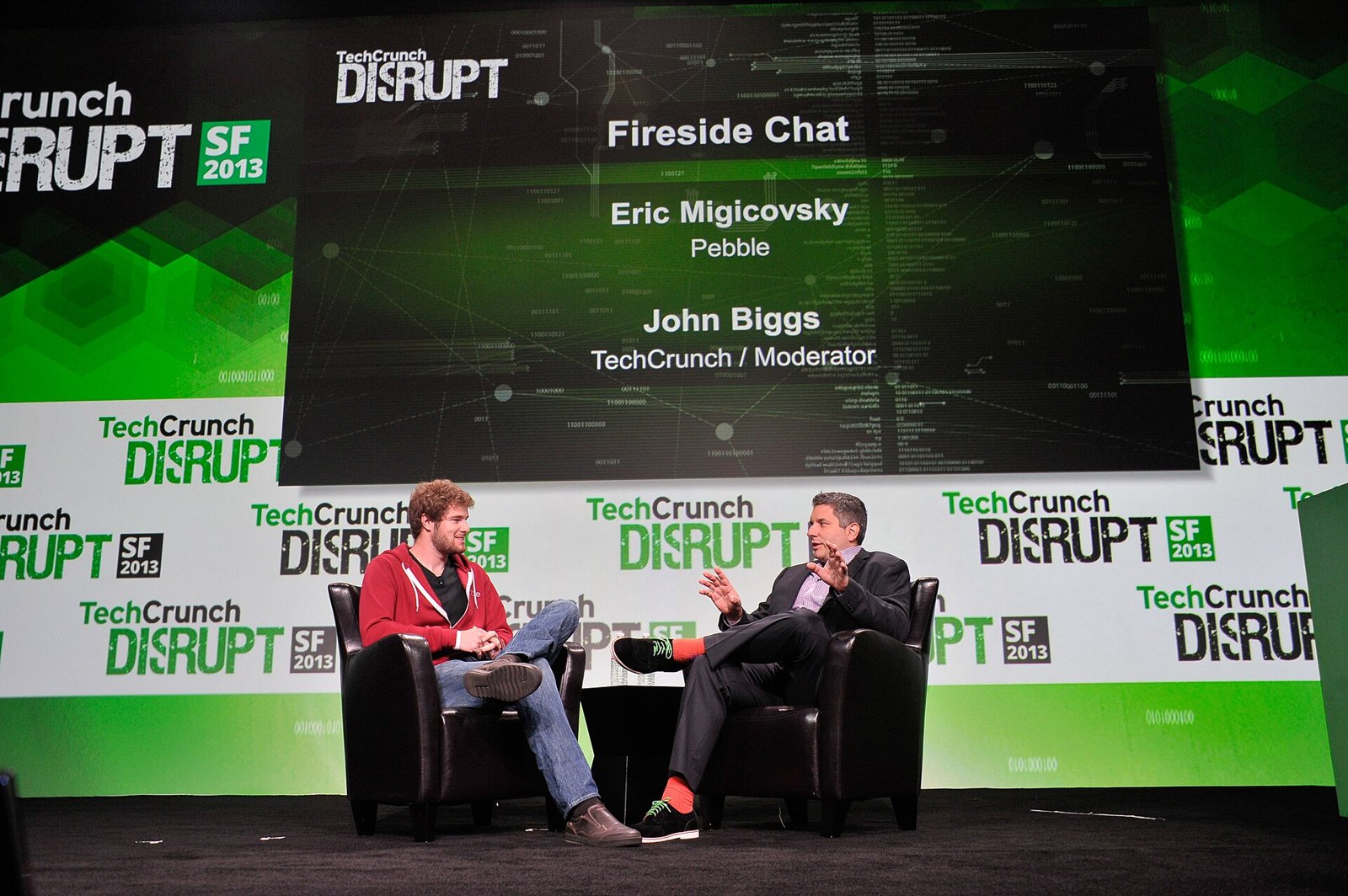
Photo: Eric Migicovsky (left) in a fireside chat at TechCrunch Disrupt SF 2013. TechCrunch, CC BY 2.0, via Wikimedia Commons.